What Makes a Letter Worth Keeping
Five things the letters people actually keep have in common, and why none of them is good handwriting.
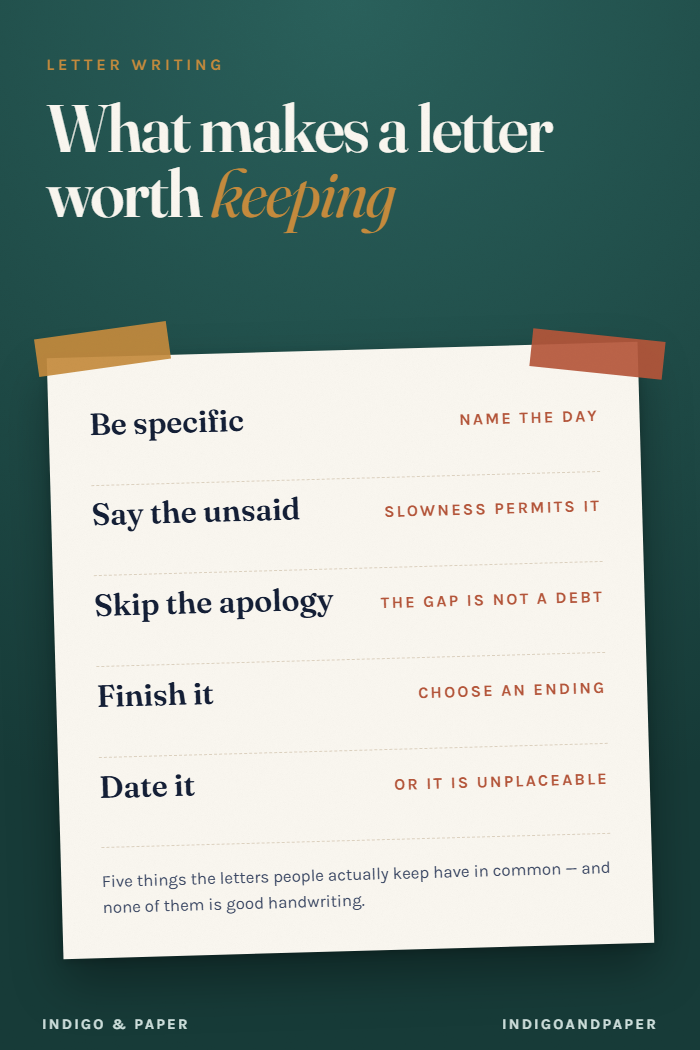
People keep a surprisingly small fraction of the letters they receive. The ones that survive a house move have things in common, and handwriting is not one of them. Neither is stationery, length, or how much the writer cared — plenty of heartfelt letters go in the recycling.
Here is what the survivors share.
1. They are specific about a moment
"I hope you're well" is addressed to nobody. "I thought of you on Tuesday because the fishmonger had those enormous crabs again" is addressed to one person and could not have been sent to anyone else.
Specificity is what makes a letter re-readable. A general letter says the same thing on the second reading as on the first, which is nothing. A specific one puts the reader back on that Tuesday.
The practical version of this rule: name one thing that happened, with the day attached. That is usually enough.
2. They say something the writer would not say aloud
Letters are slow, and slowness gives permission. You can say a thing in writing that you would deflect from in conversation, because neither of you has to watch the other's face while it lands.
This is most of the reason letter-writing survived the telephone. If your letter contains nothing you would not have said on a phone call, you have written a transcript, and transcripts do not get kept.
3. They do not apologise for the gap
Roughly a third of the letters I have ever received open by apologising for how long it has been. It is the single most common opening in correspondence and it is dead weight.
The gap is not a debt. Nobody kept a ledger. Opening with an apology makes the reader's first emotion mild guilt on your behalf, which is a strange gift to send someone.
Start with the crabs.
4. They are finished, not merely stopped
A letter that runs out of steam and signs off with "anyway, write soon" reads as abandoned. A letter that closes deliberately — returning to something from the opening, asking one real question, or simply stating that you are putting the pen down now — reads as complete.
You do not need an ending that lands. You need an ending that was chosen.
5. Something about the object is deliberate
This is the only one that touches materials, and it is much smaller than stationery enthusiasts want it to be. It does not mean expensive paper. It means that one thing about the physical object was a decision:
- the paper is a colour you picked rather than the top sheet of the pad
- there is a date on it
- the address is written carefully, even if the letter inside is a scrawl
- something is enclosed — a ticket stub, a pressed leaf, a photograph
A dated letter on cheap paper gets kept. An undated letter on beautiful paper often does not, because in ten years nobody can place it.
The one about handwriting
Legibility matters. Beauty does not.
The letters that get kept are frequently written in genuinely poor handwriting, because handwriting is a voice and a familiar bad hand is more recognisable than an unfamiliar good one. What loses a letter is not ugliness but ambiguity — an address the postal system cannot read, a name that could be two names, a date where the 1 and the 7 are indistinguishable.
If you want to spend effort on the writing itself, spend it on the envelope, where legibility has an actual consequence. Calligraphy and hand-lettering styles are worth learning for addressing precisely because that is the one part of a letter a stranger has to read.
Inside the envelope, write the way you write.