Fold an Envelope From One Square Sheet
The four-fold square envelope, the sizing rule that stops you wasting paper, and the paper weights that actually survive the post.
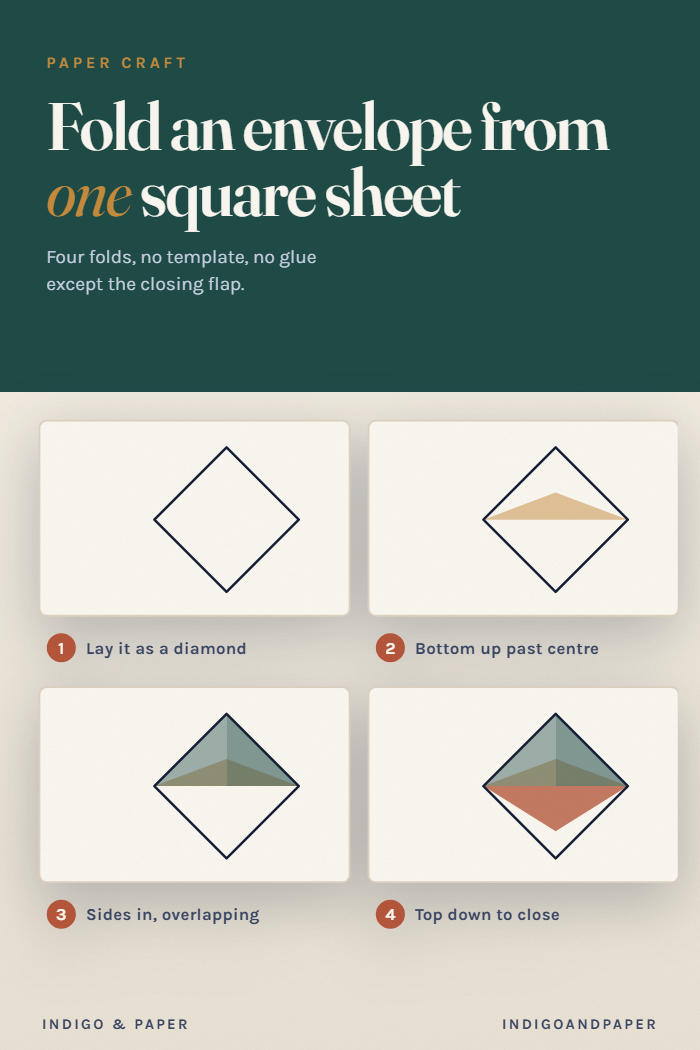
There is exactly one envelope fold worth memorising, and this is it. Four folds, no glue except at the closing flap, no template, and it works at any size as long as you start from a true square.
The four folds
- Lay the square face down, turned so it sits as a diamond — one corner at the top, one at the bottom.
- Fold the bottom corner up so its tip lands slightly past the centre. That overshoot is the pocket. If you fold exactly to the centre, the pocket is the same height as the flap and the card slides out.
- Fold the left corner in until its edge meets the centre line, then fold the right corner over the top of it. The two now overlap by a finger's width.
- Fold the top corner down over everything. That is the closing flap; it is the only part that needs adhesive.
Crease each fold with your thumbnail or a bone folder before you move to the next one. Half-committed creases are why the fourth fold never sits flat.
Sizing it without wasting paper
The rule people usually give — "the square should be twice the card" — is wrong often enough to cost you a sheet every time. The honest version:
Your finished envelope is roughly half the square's diagonal wide, and a little less than half its diagonal tall, because the pocket fold eats into the height.
So work backwards from the card and add slack. For a card that measures 5 inches across, you want the finished envelope about 5½ inches across, which means a square of roughly 7¾ inches. In metric: finished width × 1.5 gets you close enough to test.
And test it. Fold one from newspaper before you cut into good paper. Two minutes of newsprint has saved me more sheets of decent stock than any measurement formula.
Paper that survives the post
Weight matters more than anything decorative here.
- 80–120 gsm — the sweet spot. Folds crisply, holds a crease, feeds through sorting machinery without complaint. Most patterned scrapbook paper lives here.
- 120–160 gsm — workable, but crease it with a bone folder or the fold will bruise and show a white line along the spine.
- Above 160 gsm — stop. Card stock cracks along the fold, and four layers meeting at the closing flap makes a lump thick enough that the envelope gets kicked out of automated sorting and hand-processed, which is slower and sometimes surcharged.
One more practical constraint that catches people out: a square envelope is not a machinable shape in several postal systems, including the US, and attracts a surcharge. The fold above produces a rectangle, not a square, which is exactly why it is worth learning rather than simply folding a square in half. Check your own postal service's minimum and maximum dimensions before you commit to a size for a whole batch — the rules are published and they are stricter than most people expect.
When a template is worth it
Hand-folding is fine for one letter. It stops being fine at about the tenth, because the variation between them becomes visible when they sit in a stack, and because measuring a fresh square each time is the slow part — not the folding.
For a batch, cut with a template. A cutting-file template gives you the square and the fold lines scored, which is the part that actually saves time: a scored fold is straighter than a thumbnailed one and it survives thicker paper. The envelope template I use is an SVG cut file, so it works on a cutting machine, and it prints and cuts by hand equally well if you do not have one.
If you are only ever making one at a time, skip it. The fold above needs nothing but a square and a fingernail.
The failure everyone hits once
The pocket fold and the closing flap overlap, and if the pocket is too tall the flap has nowhere to seal except onto the pocket itself. It looks fine when you close it and it tears the letter when the recipient opens it.
Fix it by shortening the bottom fold, not by lengthening the top. The pocket only needs to clear the card by a few millimetres.