Why Habit Trackers Stop Getting Filled In
The grid fails in a specific, predictable way around day nine. Here is the mechanism and three layouts that avoid it.
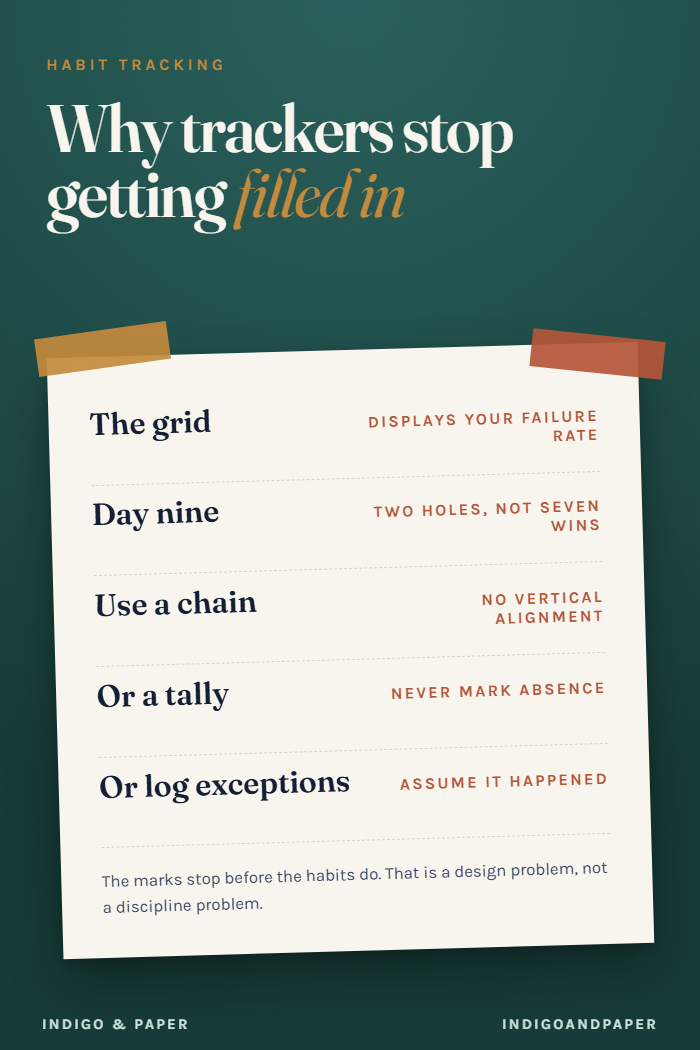
Almost every habit tracker dies in the same week. Not gradually — there is a clean edge in the grid where the marks stop, and it is usually somewhere between day eight and day twelve.
That consistency is the interesting part. A tool that failed for personal reasons would fail at random times. A tool that fails on schedule has a design problem.
The mechanism
A habit tracker grid does three things at once, and the third one kills it.
- It reminds you to do the thing. Useful.
- It records whether you did. Useful.
- It displays your failure rate, permanently, in a format optimised for spotting gaps. Fatal.
The human eye finds gaps in a grid instantly — that is what grids are for. So by day nine, when you have missed two days, the page does not read as "seven out of nine". It reads as two holes, because the holes are what your visual system extracts first.
And then the tracker stops being a tool and becomes a scoreboard you are losing on. The next thing you skip is not the habit. It is the filling-in — because filling it in is now the act of recording a loss.
Which is why the marks stop before the habits do. The gap in the grid is not evidence you abandoned the habit; it is evidence you abandoned the grid, and those get confused constantly.
Three layouts that do not do this
The chain, not the grid
One row per habit, running across a full page, with no vertical alignment between rows.
Removing the vertical alignment removes the ability to scan down a column and see a bad day. You can still see a long unbroken run, which is the motivating signal, but a missed day sits in the middle of a line rather than forming a visible hole in a lattice. Same information, different salience.
Count up, never mark absence
Instead of a box per day, keep a running tally: a number you increase when you do the thing.
There is no representation of a miss at all. Twenty-two swims in six weeks is a fact; the fourteen non-swimming days simply do not exist on the page. This sounds like self-deception and mostly is not — you are not trying to audit yourself, you are trying to keep doing a thing.
The tally also handles the case the grid handles badly: habits that were never meant to be daily. A grid silently declares every blank a failure, including on the four days a week you never intended to swim.
The exception log
Invert it. Assume the habit happened, and only write down the days it did not, with one word for why.
This works startlingly well for maintenance habits — the ones you actually do most days and only want to notice slipping. The page stays nearly empty, which is accurate. And the one-word reasons accumulate into something a grid can never give you: travel, travel, ill, travel is a diagnosis, and it tells you the habit does not need more discipline, it needs a travel version.
Choosing between them
- Building something new, daily, where streaks genuinely motivate you → chain
- Something you want more of, but not on a fixed schedule → tally
- Something you already do and want to protect → exception log
The grid is fine for exactly one case: a short, deliberately time-boxed challenge where the end date is close enough that the failure display never gets long enough to matter. Thirty days, then the page is done and you turn it.
If you like the grid anyway
Plenty of people do, and the aesthetics are genuinely part of the appeal. Two adjustments make it survive much longer:
- Fill missed days with a different mark rather than leaving them blank. A dot, a diagonal line, anything. A marked miss reads as data; an empty cell reads as an accusation. This one change is the single biggest improvement available.
- End the tracker at the month boundary and start a fresh one. Do not run a continuous multi-month grid. A bad month should not be visible from a good one.
For pre-made layouts, the free bullet journal sticker set includes tracker pieces, and it is a sensible thing to test before committing an evening to ruling your own — you will find out within a week whether the format suits you, which is the only question that matters here.