Five Bullet Journal Spreads That Earn Their Page
Most spreads are decoration with a grid on it. These five change a decision you would otherwise make badly.
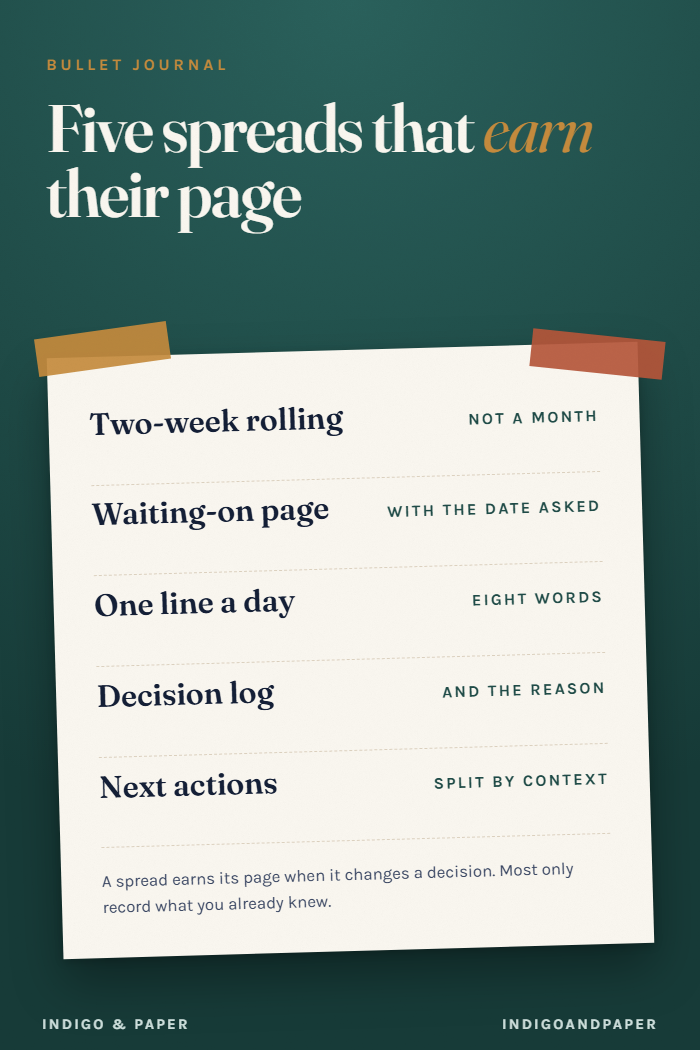
A spread earns its page when it changes a decision. Most do not. They record something you already knew, in a prettier format, and the cost is forty minutes of ruling lines.
Here is the test I apply before drawing anything: what will I do differently because this exists? If the answer is "nothing, but I'll be able to look back at it", that is a log, not a spread, and a log belongs on one line in the daily.
Five that pass.
1. The two-week rolling calendar
Not a month. Two weeks, always starting today, redrawn when you turn the page.
A monthly calendar answers "what is happening in June", which you rarely need. A two-week window answers "can I say yes to this", which you need constantly. The monthly view makes the fourth week feel empty and available — it is not empty, it is simply too far away for anything to have been booked yet, and that illusion is how people over-commit.
Redrawing it is the feature, not the cost. Ten seconds of re-entering the fixed commitments is what keeps them in your head.
2. The waiting-on page
One column: what you are waiting for. Second column: who owes it. Third: the date you asked.
This is the highest-value page in any journal and almost nobody keeps one. Every stalled thing in your life is stalled because it left your head when it left your hands. The third column is what makes it work — an item that has been sitting for three weeks looks different from one that has been sitting for two days, and you can only see that if you wrote the date down.
3. The one-line-a-day year
A single page, ruled into the days of the year, with room for about eight words each.
The constraint is the point. Eight words forces a choice about what the day actually was, and that choice is the reflection — you do not need a separate gratitude spread, because picking the eight words is the exercise. And unlike a daily journal it survives being skipped, because you can fill in three days at once without it feeling like a failure.
4. The decision log
Date, the decision, the reason, and what you expected to happen.
Then leave it alone for six months.
Almost nobody keeps this, and it is the only spread that gets more valuable with time. Read back, it shows you which of your reasoning patterns are actually reliable — not which decisions turned out well, which is mostly luck, but which reasons kept being right. That is not visible from memory, because memory quietly rewrites the reason to match the outcome.
5. The next-actions list, split by context
One list per context — at the desk, on the phone, out of the house, needs someone else — rather than one list per project.
Project lists are for planning. Context lists are for doing. When you have fifteen minutes and a phone, a project list makes you read twelve irrelevant items to find the one you can act on; a context list hands it to you.
The four that usually do not earn their page
Said plainly, because these are the ones that eat the most time:
- The habit tracker, at least in its usual grid form. It has a specific failure mode that is worth its own discussion — see why habit trackers stop getting filled in.
- The mood tracker. Colouring a square at day's end reliably reports how the last hour went, not the day, and the pattern you find in it is mostly an artefact of when you filled it in.
- The elaborate monthly cover. Beautiful, and it delays the month starting by an evening.
- The savings or reading thermometer. A progress bar you colour in tells you what a single number would tell you, and takes a page.
None of these is wrong. If drawing them is the part you enjoy, draw them — enjoying it is a real reason. Just do not confuse them with the spreads that are doing work.
Setting up faster
The reason people abandon journals in February is almost never motivation. It is that the setup cost per month is an hour, and an hour is easy to not have.
Pre-made spread and sticker sets cut that down, which is the only reason I use them — not for decoration but so that a new month costs five minutes instead of an evening. The craft and planner subscription I pull from covers printable spreads, and there is a free bullet journal sticker set worth starting with before you spend anything, because it will tell you quickly whether pre-made pieces suit how you work. Plenty of people find they hate them.